 Kuadri
What each rota code means
Most nursing rotas use the same shorthand. Exact times vary by hospital; the colours below are the ones Kuadri uses:
- EEarly. Usually 7am to 3pm.
- LLate. 1pm to 9pm, give or take.
- NNight. 9pm to 7:30am; it crosses midnight.
- SPost-nights day off. The day you come off a night shift in the morning. Not a real day off: you worked until breakfast and spend the day catching up on sleep.
- ODay off. A real day off, no shift and no sleep debt.
The rotating E-L-N pattern
The ward classic: you rotate through earlies, lates and nights, with a post-nights day after each run of nights. One week can look like this:
And the following Monday is off. The wheel starts again wherever it left you.
- Shares the good and the bad across the team
- Nobody carries all the nights
- Your body never settles into a sleep routine
- Planning life beyond next week is hard
- Post-nights days eat into what looks like rest
12-hour shifts
Two blocks, day (8am–8pm) and night (8pm–8am), typical of ICU and A&E. You concentrate the hours into fewer days:
Four shifts and you have done 48 hours. The rest of the week is yours (and the sofa's).
- Many more days off per month
- Fewer commutes to the hospital
- Hour 11 is nothing like hour 2
- On working days you disappear for your family
The 2-2-3 (Panama) schedule
The 2-2-3 repeats a two-week cycle: work 2, off 2, work 3; the next week inverts. Look at the whole cycle, because its selling point is visible:
Week 1 you work the weekend; week 2 you get it off in full, Friday to Sunday. And so on every two weeks, forever: you can plan life months ahead.
- Never more than 3 days in a row
- You know your free weekends months ahead
- Usually paired with 12-hour shifts
- Half your weekends are still working weekends
The three patterns, side by side
One row per pattern, so you can compare what each trades off:
| Pattern | Shift length | Max days in a row | Free weekends | Typical of |
|---|---|---|---|---|
| Rotating E-L-N | 7–10 h | 5–6 | 1–2 a month | General wards |
| 12-hour shifts | 12 h | 3–4 | Varies by rota | ICU, A&E |
| 2-2-3 (Panama) | 12 h | 3 | 2 a month, fixed | Continuous cover units |
What your rota must respect
Whatever the pattern, minimum rest rules apply. In the UK these come from the Working Time Regulations; most of Europe transposes the same EU directive:
The problem is never the pattern
Any of the three can work. What burns people out is not knowing next month's rota, last-minute swaps with colleagues, and counting nights by hand to check the night differential on your payslip.
How Kuadri handles it
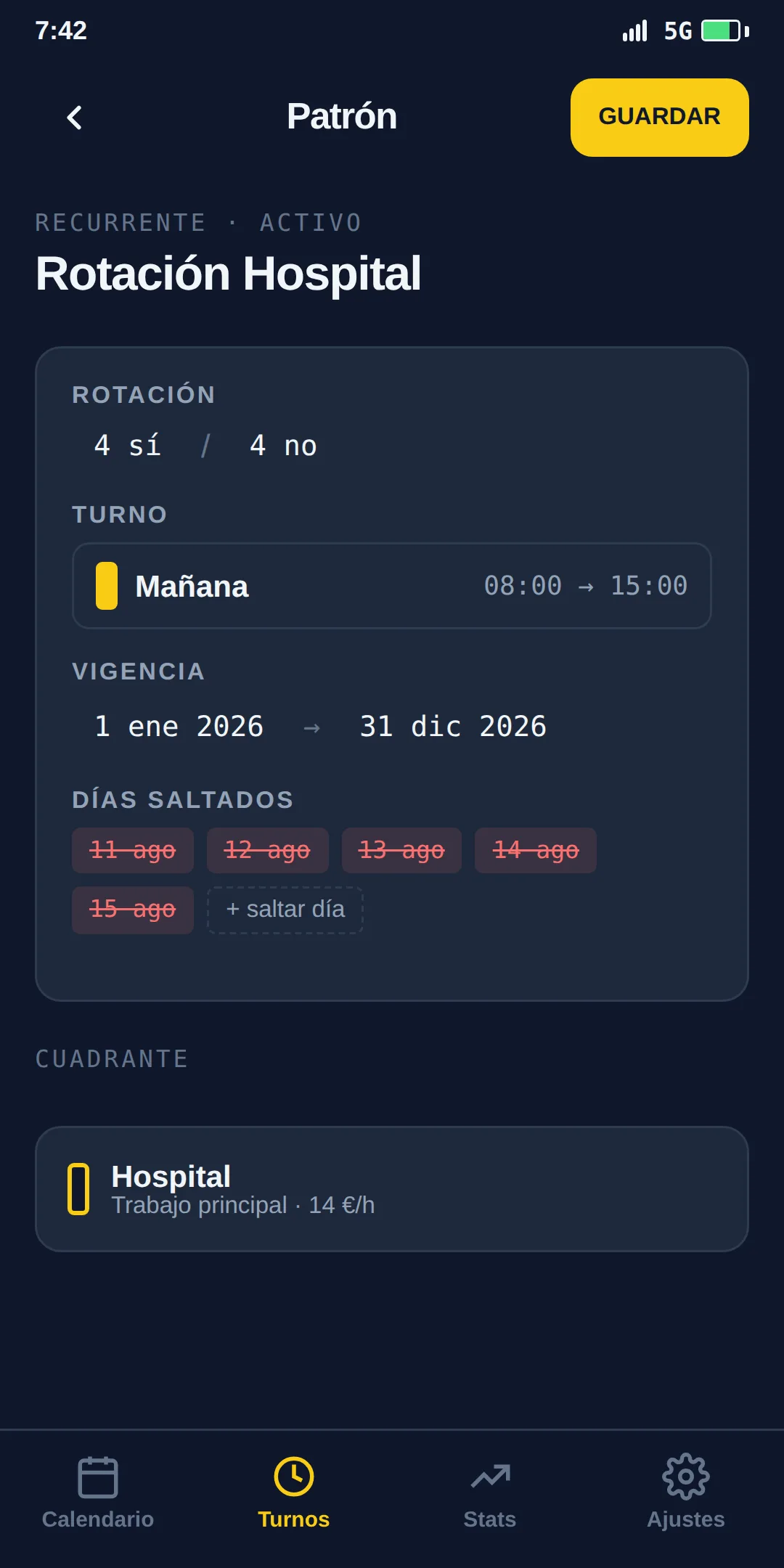
Kuadri ships these rotations built in. Pick your pattern (rotating E-L-N, 12-hour, 2-2-3, DuPont, Pitman, 4-4…) and the months fill themselves in. Swaps with colleagues are logged with a who-owes-whom balance, pay is worked out minute by minute with night, weekend and holiday differentials, and your family can see when you are off, never what you earn.
The app is free, works without an account and offline, and has no ads.
Quick questions
What do E, L and N mean on a rota?
The three classic shifts: E is early (usually 7am–3pm), L is late (1pm–9pm) and N is night (9pm–7:30am). Exact times vary by hospital; the codes are near-universal.
What is a post-nights day off?
The day you come off a night shift in the morning. Not a real day off: you worked until the morning and spend the day recovering sleep, which is why good rotas count it separately from leave.
What is the 2-2-3 or Panama schedule?
A two-week cycle: work 2, off 2, work 3, then it inverts. Never more than 3 days in a row, and every other weekend off.
How do 12-hour nursing shifts work?
Two blocks, day (8am–8pm) and night (8pm–8am). More days off in exchange for much longer shifts. Common in ICU and A&E.
How do I keep my rota on my phone?
Pick your pattern once in Kuadri and the months fill themselves in. Swaps stay logged, pay is calculated with your differentials, and your family can see when you are off. Free, no account.